
Acting collectively
There is a need for evolution in our collaborative structures and frameworks, within our training / educational spaces, as well as within creation and production. It’s imperative to rethink our existing systems so that they can become more inclusive and adapted to the diverse realities of the individuals they serve, while also focusing on group process, new ways of sharing roles and responsibilities, and new methodologies. Collective work encourages alignment with shared values, which must be chosen together and clearly identified in order to ensure the success and cohesion of a project, whether educational or artistic. This involves, for example, the creation of healthy and supportive learning environments for all students/learners, where pedagogues also feel less isolated and enjoy greater recognition from their peers and the school’s management. By creating supportive and welcoming groups, with a chosen set of people, artists, pedagogues, and students/learners can grow and work in environments where they feel involved and valued.
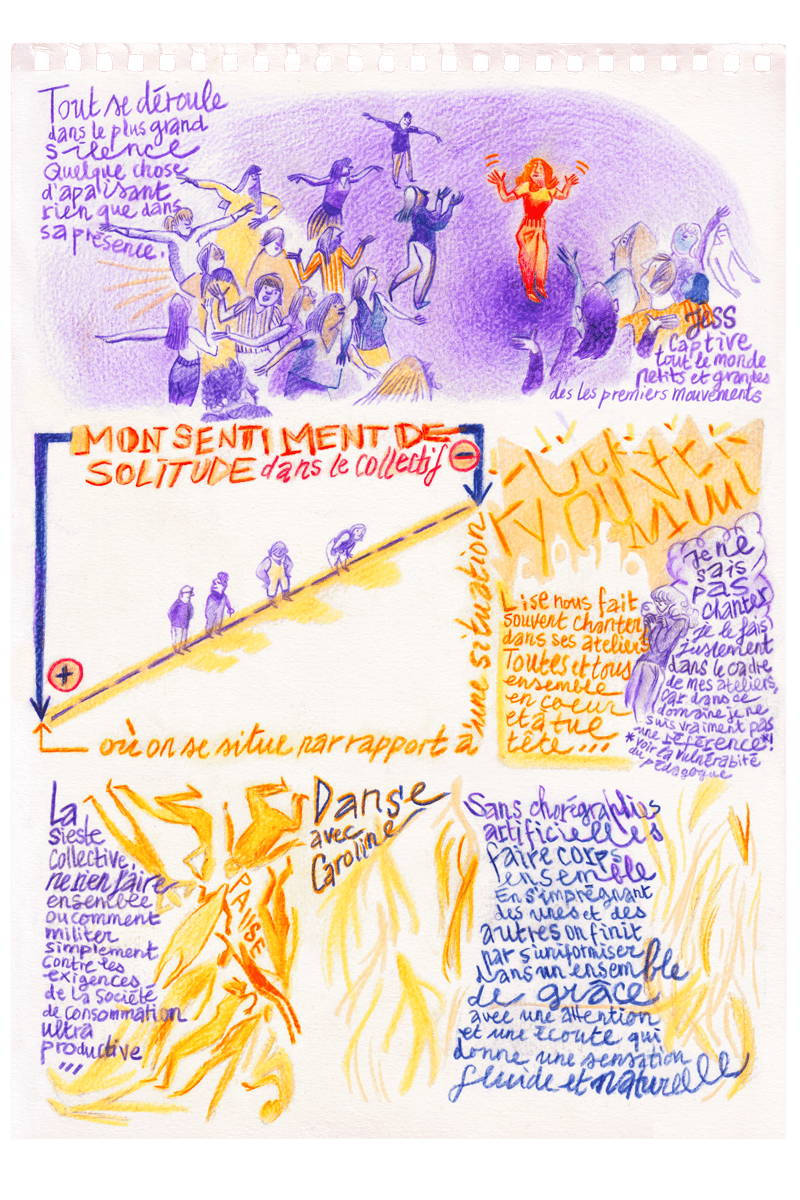
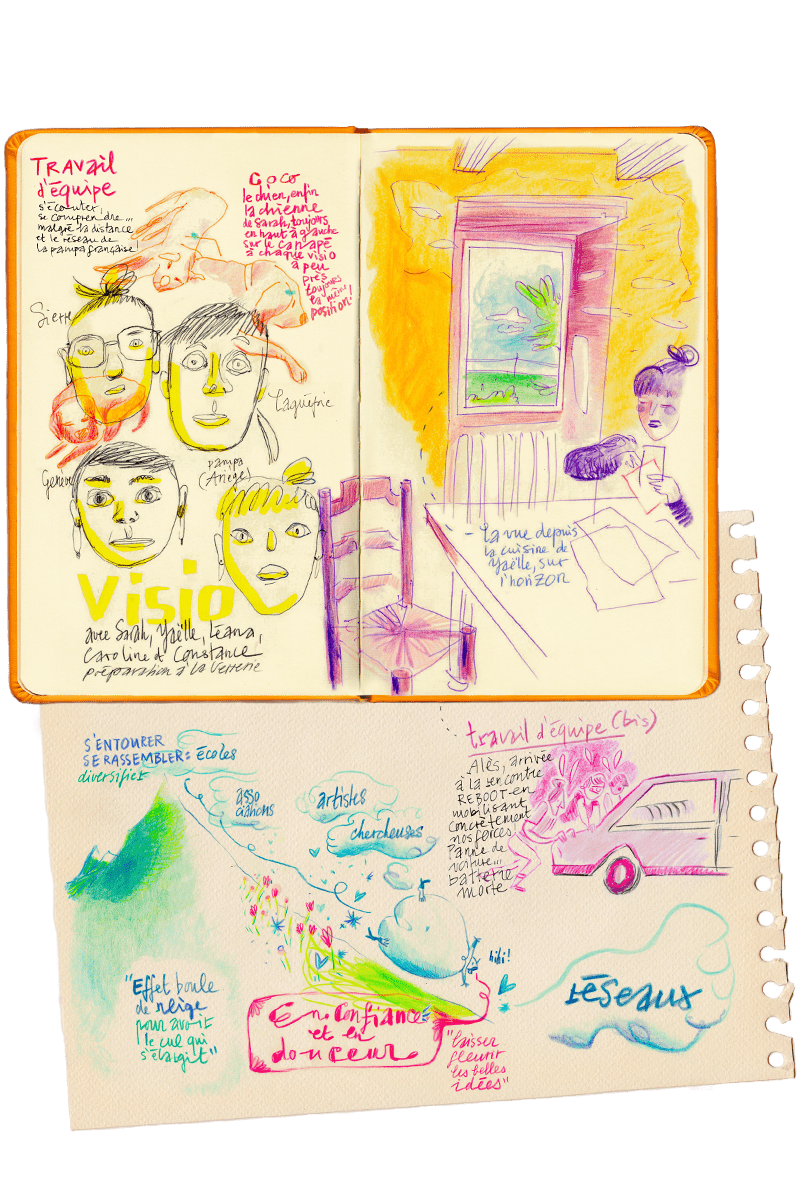
Togethering
Thinking about one's place within a group or team encourages the establishment of long-term practices within a project that is perceived as a whole, rather than as a series of individual and potentially contradictory practices, all the while accepting how different artistic disciplines lead to varying methods and relationships to the body. The aim is to break free from the imaginary world of a project led by an individual, which isn't anchored in collective discussion and may not even exist at all, and instead come together to create a concrete project driven by all members of a collective. Group meetings and workshops highlight the importance of having common dynamics that inform the practices of all pedagogues, so as to ensure a positive and consistent working and pedagogical environment. Becoming a pedagogical team therefore requires finding common values, which may take the form of writing a charter or code of conduct, as well as sharing teaching methods and practices.
Working together, differently
The arts and culture sector is characterized by diverse working and employment conditions, and varying conditions of access to the labor market. As a result, workers in the arts will demand different statuses and roles; they fight different battles in their respective fields. So how then can we work collectively, more horizontally? And with which tools? It begins with defining one’s place and status within a group or institution, clarifying and discussing issues of salary, recognition, evaluation, and professional development. It’s also essential to recognize individual knowledge and collective skills, including both formal and empirical knowledges. Finally, it’s important to identify physical, mental, and emotional loads in order to collectively rethink their distribution.
Laws and regulations protect and govern work, within the context of an artistic troupe, a cultural institution, a non-profit, or a school. In order to clarify power relations and define the work to be done, thereby avoiding the common invisiblization of certain tasks, it’s useful to reference local laws and regulations, discuss them, and devise ways of working together within the legislative framework (e.g., writing a charter, rethinking communication tools). Commonly invisiblized tasks include: the preparatory work of pedagogues, the mental load of monitoring a student/learner in difficulty, the need to respond to calls for projects, administrative tasks, human resources management, travel time, etc. Thinking about work collectively and experimenting with modes of organization includes questioning the myths around “careers,” the necessity of work, the pleasure of working, and the political models in which work can be framed (salary versus unpaid work, notions of career, overproduction, the value of work in the labor market, etc.). Working together also means rethinking the spaces where collective struggles take place (non-profits, unions, activist groups) in order to organize, participate, and unite.
Celebrating Struggles
Finding areas of enjoyment and safety is essential for the well-being and fulfillment of all members of a group or collective. Workshops that combine formal and informal elements are of paramount importance. They create discussion spaces for all participants, fostering connection and the sharing of resources and experiences. These moments are precious for strengthening cohesion and solidarity within groups and collectives. In addition, the creation of celebratory rituals brings joy and pleasure to the forefront within the contexts of creation, work, transmission, and teaching. Institutions often lack recognition for themes deemed “intimate” such as motherhood, gender transition, and the feeling of exclusion experienced by queer and racialized people. Coming together as a group or a collective, particularly in an intentionally non-mixed environment (such as queer or single-sex spaces), enables the sharing of resources and creates a space in which it is possible to question how we perceive ourselves and present ourselves to others. Embracing one’s identity, finding and proving one’s legitimacy, and establishing strategies of visibilization are all essential steps toward full recognition of oneself and one’s work. Groups and collectives offer spaces to recharge, feel safe, and rejoice together.
Conflict management
Historically, feminist movements have sought to organize themselves in a more horizontal and democratic manner, so as to limit power dynamics within their organizations. Many innovative tools and organizational structures have emerged since the 1970s, such as cooperative or participatory management, non-violent communication tools, or spaces that are intentionally non-mixed so as to be safe(r). These models aim to break with institutionalized hierarchies and thus counter traditional patriarchal structures. They seek to avoid reproducing oppressive systems, particularly in terms of traditional judicial-legal systems. Faced with situations of violence (gender, race, class), there is never a single answer. Within activist collectives, conflict management is widely discussed. Practices often draw on different approaches and intervention methods based on the underlying principle that groups are never stable and conflict is inevitable. Managing conflict in this manner also means recognizing that conflict can generate valuable change. It’s possible to embrace the opportunity for growth and see what emerges from the conflict.
However, not all of the practices undertaken by activist groups can be immediately transposed to all professional settings. Indeed, when vertical working relationships are involved (i.e. with hierarchical roles), it’s often more complex to resolve conflicts with collective and horizontal methods. There are collectives specialized in offering tools adapted to different contexts and conflicts. In the professional sphere there are also necessary procedures in place to protect workers from potential abuses of power. Responding to conflict within a group, workspace, or collective is therefore always complex. In the performing and visual arts, the process of examining conflict management, inventing spaces in which to respond to violence, sharing personal stories and histories, and reimagining the collective have all influenced artistic approaches. This also contributes to shifting our approaches to violence in the arts by questioning the ways in which it is depicted on stage or elsewhere.
Sharing knowledge and skills
Building a collective enables the pooling of resources and tools, the creation of networks (of support, distribution, exchange) and the sharing of practices, both among peers and between pedagogues and students/learners. The collective, in the broadest sense, invites us to recognize and accept that everyone possesses skills and knowledge, and that the roles of pedagogue and student/learner can shift and even reverse. This also means rethinking teaching to be more horizontal, from peer to peer, rather than through a vertical relationship between one who possesses knowledge and one who does not. The importance of the collective and the choice of its members (including forms of intentionally non-mixed groups of women and/or queer people) constitute not only a strategy for visibility, but also a way of avoiding having to carry out projects alone, thus offering a space of safety both artistically and on a personal level.
Resources
- HARNEY, S. et MOTEN, F. (2022), Les sous-communs. Planification fugitive et étude noire, Les presses du réel
- KUNST, B. (2015) Artist at work. Proximity of art and Capitalism, Zero Books
- PROVANSAL, M. (2022) Artistes mais femmes. Une enquête sociologique dans l’art contemporain, ENS Éditions
- SCHULMAN, S (2021), Le conflit n’est pas une agression, traduction française de Julie Bortin Zortea et Joséphine Gross, éditions B42.
- STARHAWK (2021), Comment s’organiser? Manuel pour l’action collective, Cambourakis
- BUTLER, J. (2016), Pluralité, performativité et politique, Fayard.
- ZORTEA, J.B. et DRUL, L. (2022) Aujourd’hui, on dit travailleur·euses de l’art, 369 éditions
- Collectif Fracas
- Continuité revenus
- Wages for wages against