Taking care
Our values include taking care of ourselves, of others, of the collective; listening, identifying our own limits and collectively developing observation practices from our place as pedagogue, for and with students/learners; sharing our energies, making ourselves available, committing to and relying on each other. One of the important issues within teaching and educational practices is the preservation of physical, mental, and social health. Taking care is first and foremost the creation of spaces for care to exist. In this space, the body’s rhythm as well as creation time, pedagogical time, and everyday time are all allowed to coexist, without being in opposition. This also means allowing each person to express their individual subjectivities, expressing with words what has often been negated or silenced by years of practice, social constructs, incorporated norms, and the need to perform. Within a group, a troupe, a school, the responsibility of “taking care” requires a just and fair distribution of mental, physical, and emotional loads.
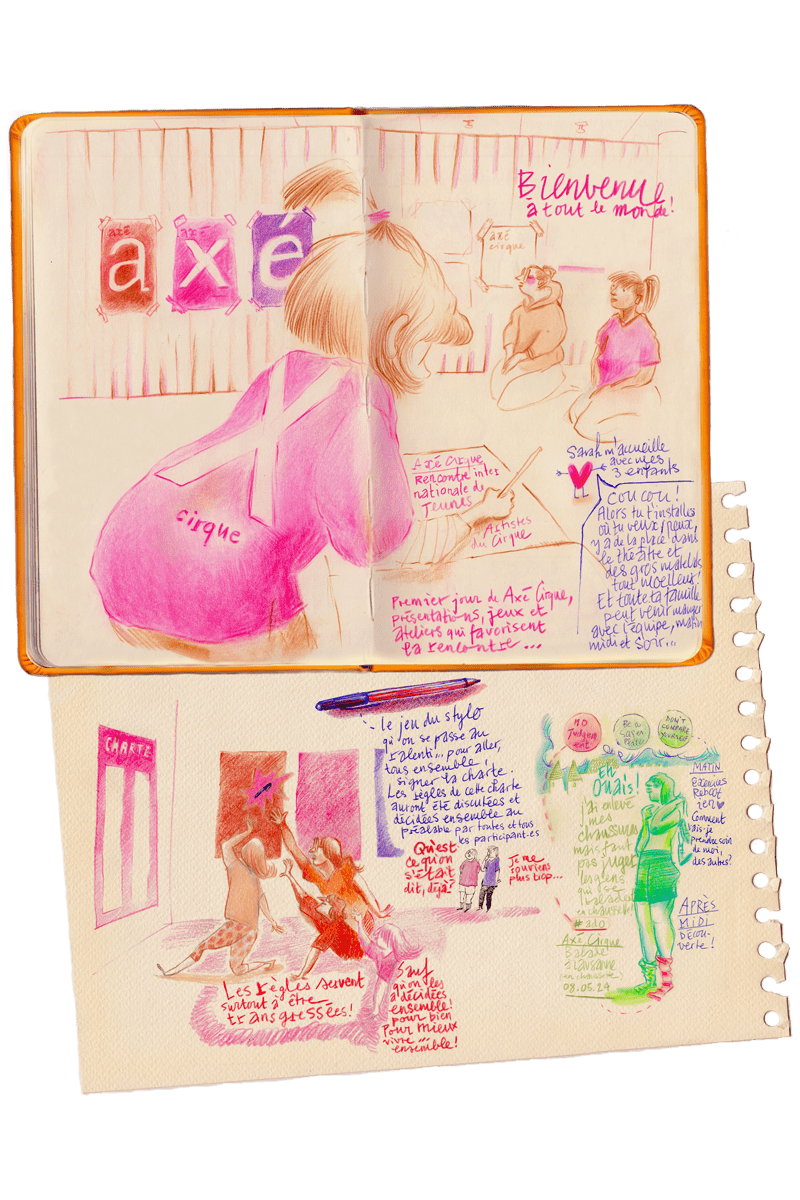

Certain contextual elements such as working conditions, accessibility, rhythms, social and political issues will all contribute to defining relationships to care. Mindfulness practices often allow us to bring our attention to fairly distributing mental, physical, and emotional loads. Care sometimes means questioning habits, finding other paths and methods, and seeking out approaches from other artistic fields. It is important to take into consideration how environmental and social factors (discrimination, marginalization) influence how care is included in both professional and non-professional practices. Care is about engaging the body and the perceptions in a full and holistic awareness anchored in movement and in the imagination.
Bringing attention to risks and vulnerabilities
Engaging the body on a daily basis in a high-intensity practice places both educators and students/learners in risky situations or ones where they may feel vulnerable. Naming questions around physical, mental and social health within a group makes these questions real and tangible. To create opportunities for listening, it’s essential to begin by naming situations (fatigue, overtraining, motivation, availability). It’s important also to create spaces to name or share feelings through regular “body scan” exercises and to create sharing circles and the sharing of information (physical, mental, social injuries). This can mitigate the pressure to hide pain or discomfort, as well as the fear of speaking up about working conditions, of appearing “weak,” the constant adaptation to dangerous situations, the feeling of loneliness, or the fear of destabilizing a group, a pedagogical relationship, or a project –all of which lead to hiding information, either consciously or unconsciously. By making the invisible visible, we have an opportunity to collectively pay attention.
Responsibility and vigilance
Taking care requires engaging one’s responsibility as educator and pedagogue, without stepping out of one’s role. The role of the pedagogue is not to diagnose, whether the problem is physical or psychological, but the pedagogue must nevertheless equip themselves with observational tools so as to notice and guide. This makes it possible to identify one’s own boundaries and allows each person to set their own limits and express them, at a given time, in a specific context. Some of the many responsibilities that the pedagogue takes on include: setting up a safe(r) working environment; having reasonable objectives; analyzing the context for giving technical feedback to students/learners (i.e. including in one’s analysis fatigue, time of day, conditions, stakes, physical and psychological availability); identifying, measuring and discussing risk-taking together; protecting from risks. By developing confidence, and by including practices that allow for more acute awareness (somatic and attentional practices), responsibility and safekeeping practices can be shared between pedagogues, between pedagogues and students/learners, between students/learners themselves.
Preparation, action, recouperation
[1] By “become available” we mean that these tools aim to increase our awareness of body and mind ; becoming more aware is a first step towards becoming more available and present, both for oneself or for the group. These tools therefore utilize different methods to work towards this awareness.
Resources
- CHARMATZ, B. (2009), Je suis une école, Les Prairies ordinaires
- CRICKLAY, C. et TUFFNELL, M. (1999), Body, Space, Image. Notes toward Improvisation and Performance, Dance Books Ltd
- FORTIN, S. (2008) Danse et santé. Du corps intime au corps social, Presses de l’Université du Québec
- LEGENDRE, F. (2016) « Devenir artiste de cirque : l’apprentissage du risque » dans La Prouesse et le risque, La Découverte
- GROSSTEPHAN, V. (2018) « Former à la prise de risque dans les écoles de cirque : une étude exploratoire » dans Carrefours de l’éducation, Armand Colin
- Radicalizing Care. Feminist and Queer activism in Curating, ouvrage collectif (2022), MIT Press
- Site web « Écouter le travail »
- Formation premiers secours CH et FR
- Formation premiers secours en santé mentale CH et FR
- Individus en mouvements