Transmission of knowledge: which roles?
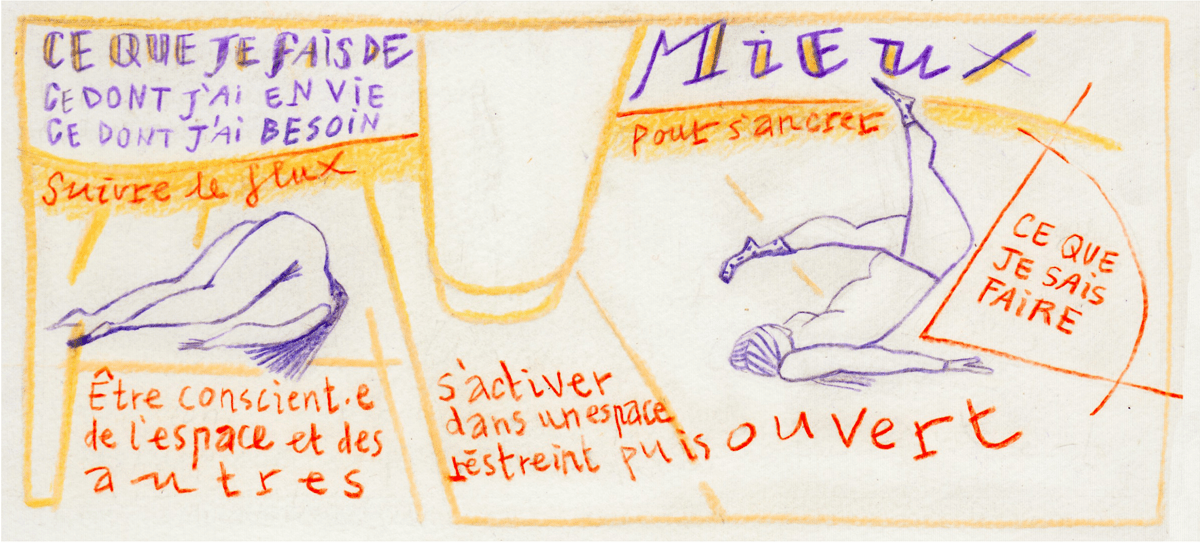
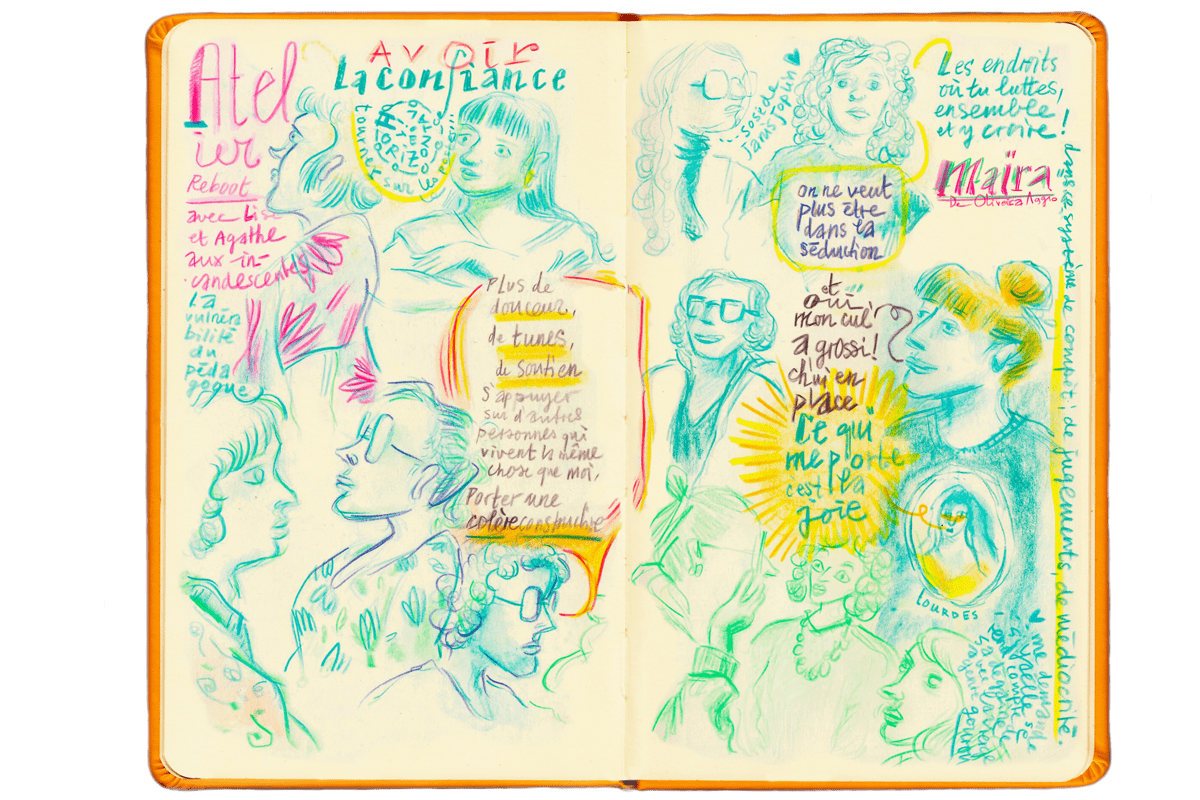
Educators expressed difficulties in finding the right roles in relationship to their students/learners. These educators seek to give meaning to their teachings and to better support their students/learners, while also making do with institutional, disciplinary, training, and economic requirements. This involves a search for a balance between the expectations and desires expressed by students/learners, and the educators’ own vulnerabilities. Educators seek to support their learners’/students’ individualities and particularities, while co-creating a safe and engaging space in which they avoid reproducing well-known patterns of power and control. When they’re also artists, the educators strive to reconcile their roles as both artist and pedagogue, and align their values with what is feasible, while maintaining a correct relational distance with their students/learners. The pedagogues also struggle with balancing spontaneity and exploration with the need for safety and control. Though there is a desire to let go of these dilemmas in order to better teach, the pedagogues refuse to impose this double bind on the students/learners. The educators seek to encourage safe and constructive risk-taking, without unnecessary pressure.
The educator's legitimacy and vulnerabilities
K
L
Identification of the educator's vulnerabilities allows for the construction and rethinking of teaching practices, so as to include these vulnerabilities and mitigate them. During the Reboot workshops there were collective spaces in which to share about concrete situations. The most prominent vulnerabilities identified were solitude and the sense of illegitimacy. Many pedagogues feel insufficiently prepared, as they don't have full mastery of all the subjects they need to teach, and find it difficult to introduce new disciplines or practices. Pedagogues feel a pressing need to "be a team," so as to share moments together and have concrete discussions about their practices. These moments of discussion and exchange are essential in establishing a coherent pedagogical project that is enriching for all team members.
Pedagogy and power dynamics
K
L
It's important to be aware of the power imbalance that is created by the vertical and asymmetric position of the educator in regards to the student/learner. The question of power dynamics between educator and student/learner also leads to the question of the appropriate relationship between them, as relationship-building takes time, at the possible expense of time otherwise devoted to learning. Finding the "right relationship" implies understanding where and how to situate oneself in regard to students/learners, and creating non-oppressive learning contexts, while taking care not to move from friendliness to friendship. From the point of view of the power dynamics between pedagogues and institutions, the crucial issues that emerge are the educator's precarity and the lack of recognition for their work. These material and moral difficulties can impact pedagogues' motivation and their capacity to provide quality education.
Alternative and radical pedagogies
K
L
Thinking through new pedagogical practices includes using tools which allow for listening and speaking consciously about power dynamics. Many of these tools have already been thought through and tested in other contexts, notably in popular education. Examples include non-violent communication, self-reflexivity, the valuing of everyone's experiences, and the fostering of safe and intimate sharing spaces. It's thus a matter of moving away from traditional methods of teaching circus, and moving closer to principles and practices of alternative pedagogies centered on the student/learner. These tools and practices value each individual's holistic development, focusing on students'/learners' specificities (in terms of learning contexts), as well as collaboration, active engagement of students/learners, and the overall fulfilment and development of each person (intellectual, emotional, social, etc.). Thus there is also encouragement to question oneself as pedagogue, as well as the power structures and inequalities present in our society, and to encourage a back-and-forth between theory and practice, and the development of auto-reflexivity and self-determination.
Resources
- HOOKS, B. (2019), Apprendre à transgresser, Syllepse
- INGOLD, T. (2018), L’anthropologie comme éducation, Presses universitaires de Rennes
- KIHM, C. et MAVRIDORAKIS, V. (2013.), Transmettre l’art. Figures et méthodes. Quelle histoire ?, Les presses du réel
- MICROSILLONS (2019), Motifs Incertains. Enseigner et apprendre les pratiques artistiques socialement engagées, Les presses du réel
- ORLANDO, S. (2024), La part affective, Paraguay Press
- PERREIRA, I. (2024) Le féminisme libertaire : des apports pour une société radicalement féministe, Cavalier Bleu
- Pour des écoles d’art féministes !, ouvrage collectif (2023), ÉSACM : Tombolo presses
- DE COCK, L., PEREIRA I. (2019), Les pédagogies critiques, Agone.